Does Memopryl Really Work? How It Works and What the Research Shows
Quick answerNo one can say yet. No trial of the finished Memopryl capsule is published, and its ingredient amounts are not published. Bacopa has the clearest result: 300 mg a day for 12 weeks improved learning in 46 healthy adults. The ginkgo and carnitine trials were weaker. Judge it with a weekly log inside the 60-day window.
Key facts
The short list, taken only from the label, the retailer pages and the linked sources.
- The label claims are Supports Concentration, Supports Brain Energy and Supports Productivity. They are support claims, not promises.
- No clinical trial of the finished Memopryl capsule has been published.
- Bacopa: 300 mg a day for 12 weeks improved learning in 46 healthy adults, only at the 12-week check.
- The large ginkgo trial (3,069 adults, 240 mg a day, median 6.1 years) did not lower dementia rates.
- Memopryl's ingredient amounts are not published, so no dose can be matched to a study.
- Buyers in the retailer's review pack most often mention 3-4 weeks. That figure is not verified.
- It does not treat or prevent dementia, Alzheimer's disease or any other disease.
What would it mean for Memopryl to work?
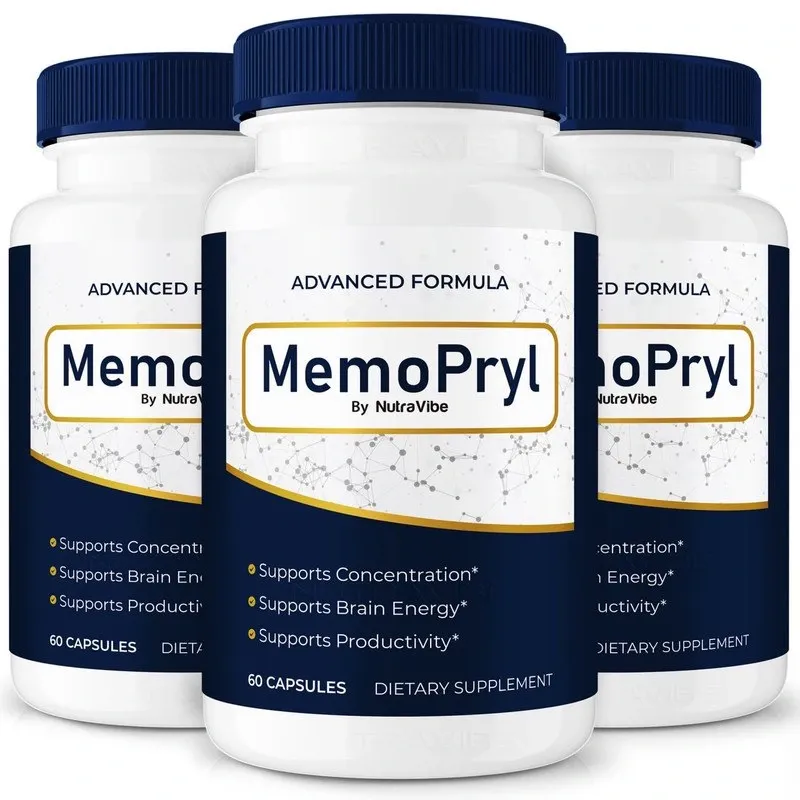
Start with the label, because it sets the bar. Memopryl says it supports concentration, brain energy and productivity. Each line carries an asterisk and the standard FDA note. These are claims about normal daily function. They are not claims about a disease.
So “work” here is modest. It might mean a steadier afternoon, an easier start on a task or a longer stretch before you drift. It does not mean a sharper memory overnight, and it does not mean treating a condition.
That is also how you should measure it. Pick one or two concrete things before you start, such as tasks finished in a normal day. Then compare, using weeks and not hours.
How does Memopryl work?
Nobody can explain how the finished capsule works, because it has not been tested as a whole. What we have is the idea behind each ingredient and what studies of that single ingredient found. The table gives both.
| Ingredient | The idea behind it | What human studies found |
|---|---|---|
| Bacopa (Brahmi) | A traditional herb for learning | Better learning rate and memory consolidation in healthy adults at 12 weeks |
| Phosphatidylserine | A fat-like part of cell walls, plentiful in the brain | Memory scores rose in older adults with memory complaints |
| N-acetyl L-carnitine | Helps cells move fats into the parts that make energy | A review of 16 trials found no case for routine use in dementia |
| Ginkgo leaf | Studied for blood flow in the aging brain | Did not lower dementia rates in 3,069 adults |
| St. John's wort | Studied for mood, not memory | Mood trials only; many medicine interactions |
| L-glutamine | A common amino acid used by the brain | A single 2 g dose did not help learning in 91 students |
A lab idea is not a result in people. Carnitine helps cells make energy, which sounds ideal for “brain energy.” Yet trials in people with memory problems did not show a clear benefit. Health agencies say direct evidence for natural products and thinking skills is still lacking (NCCIH, supplements and cognition).
Has Memopryl itself been tested in a trial?
No. We found no published trial of the finished capsule. That is the biggest gap in the whole question. A trial of one ingredient at one dose cannot tell you what a six-ingredient capsule does at unknown doses.
This gap cuts both ways. We cannot say Memopryl fails, and we cannot say it succeeds. We can only say what its parts did when studied alone.
It also means every claim you read about “before and after” results for Memopryl should be treated with care. The brand images show bottles and graphics, not photos of results.
Want to try the 60-day test?
Each bottle holds 60 capsules, prices show at checkout and the money-back guarantee runs 60 days from purchase.
Earnings note: we earn money when you buy through the buttons on this site.
Which ingredient has the strongest evidence?
Bacopa does. In a placebo-controlled trial, 46 healthy adults took 300 mg of bacopa extract a day. After 12 weeks, learning rate, memory consolidation and processing speed improved more than with placebo (Stough et al., 2001). The change did not show at earlier checks.
Phosphatidylserine comes next. In 78 adults aged 50 to 69 with memory complaints, 100 or 300 mg a day for 6 months raised memory scores (Kato-Kataoka et al., 2010). The FDA allows only a heavily qualified claim for it (FDA, qualified health claims).
Ginkgo had the biggest trial and the least encouraging result (DeKosky et al., 2008 (GEM)). Acetyl-L-carnitine looked hopeful in single trials, yet the pooled review did not hold up (Hudson & Tabet, 2003 (Cochrane)). L-glutamine has no memory dose set.
Why can the doses not be compared?
The Supplement Facts panel is not in our files, so the amount of every ingredient is not published. Studies used 100-300 mg a day of phosphatidylserine, 240 mg of ginkgo, 1,500-3,000 mg of carnitine, 900 mg of St. John's wort and 300 mg of bacopa.
Added together, those study doses come to well over 3 grams a day. How many capsules that would take depends on a serving size we cannot see. A dose below a study range is not proof the formula fails. It is simply not the dose that was tested.
St. John's wort changes the picture
Its interactions matter at any amount. If you take any prescription medicine, ask your doctor or pharmacist before the first capsule, and never stop a prescribed medicine on your own.
What do buyers say about results?
The retailer reports 4.8 out of 5 from 1,397 written reviews. Buyers like the daily capsule and the 60-day window. They dislike a slow start. Most mention waiting 3-4 weeks before forming a view.
These are the retailer's figures and are not independently verified. A review also reports a feeling, not a cause. Better sleep, a new coffee habit or simple expectation can make a week feel sharper.
That is why a plain log beats a hunch. It lets you see a trend and not a single good day.
How can you run a fair test inside 60 days?
Check your medicines first
Show the bottle to a pharmacist. Do not start if the answer is no.
Write a baseline
Rate your focus from 1 to 10 on a normal workday before the first capsule.
Take it as the label directs
The serving is not published here, so your bottle is the only guide.
Log once a week
Note sleep, caffeine, focus and any stomach upset.
Decide by day 45-50
Keep going, or call the order desk while there is time to post a return.
The window is shorter than the 12-week bacopa trial. A 60-day test can show how the capsule fits your routine and whether you notice anything. It cannot recreate a trial.
Frequently asked questions
Does Memopryl really work?
No one can promise that. No trial of the finished capsule is published, and its amounts are not published. Bacopa, one of its six ingredients, improved learning in healthy adults at 12 weeks in one trial.
Is Memopryl effective for focus?
It is labeled to support concentration, but that is a support claim and not a proven result. Results vary, and sleep and daily habits matter as much.
How does Memopryl work?
It combines six named ingredients that were each studied alone. The idea is steady daily support for concentration, brain energy and productivity. How the mix behaves has not been tested.
Why does the research not prove it works?
The studies tested single ingredients at doses we cannot match to the capsule, and some trials, such as the ginkgo and carnitine reviews, found no clear benefit.
How long should I try it?
Several weeks of steady use. The bacopa trial ran 12 weeks, which is longer than the 60-day refund window, so decide with that gap in mind.
Can Memopryl treat memory loss?
No. It is not made to treat or prevent any disease. If you notice memory changes, see a doctor.
Our view
Our view: Memopryl is a reasonable thing to ask about and a hard thing to prove. One ingredient has a clean result in healthy adults. Two have modest or weak results in older groups. One is a mood herb with a long list of drug interactions. One has no memory data.
Because the amounts are not published, the research cannot be lined up with the capsule. We would treat Memopryl as a trial you run on yourself, with a log, a pharmacist check and a decision date. If you see no change by then, the guarantee is there for that reason.
Nothing here is medical advice. A doctor is the right first stop for noticeable memory changes.
Last updated .
Curious what the packs cost today?
Checkout shows the price, shipping and tax before you pay. Clear St. John's wort with a pharmacist first.
Earnings note: we earn money when you buy through the buttons on this site.