Phosphatidylserine
A phospholipid found in cell membranes
Studied for memory in older adults at 100 to 300 mg a day. FDA allows only a heavily qualified claim for it.
Quick answerMemopryl names six ingredients in a 60-capsule bottle.
They are phosphatidylserine, ginkgo biloba leaf, N-acetyl L-carnitine HCl, St. John's wort, Brahmi (bacopa) and L-glutamine. St. John's wort calls for a medication check first.
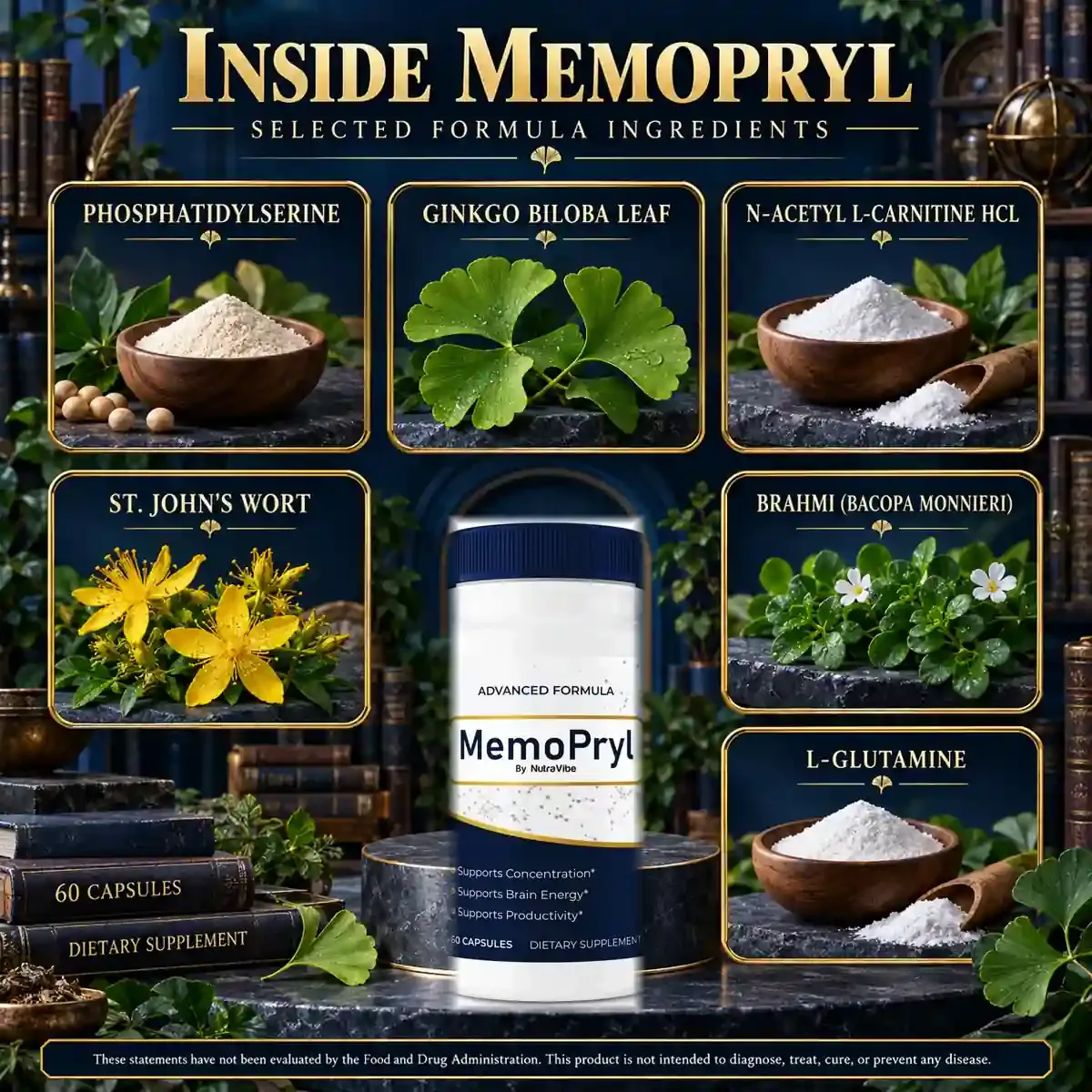
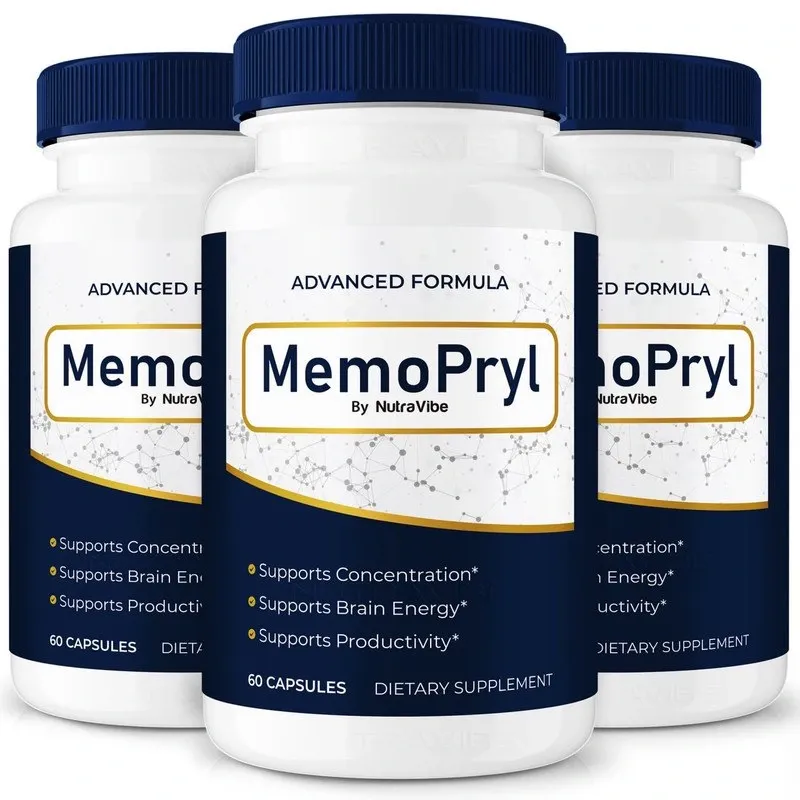
Memopryl names six ingredients on its retailer pack and in the brand's "Inside Memopryl" graphic. They are phosphatidylserine, Ginkgo biloba leaf, N-acetyl L-carnitine HCl, St. John's wort, Brahmi (Bacopa monnieri) and L-glutamine. The bottle styles the name "MemoPryl by NutraVibe," and each one holds 60 capsules.
Two of the six are herbs, and one is an herb extract best known for mood. The rest are nutrients found in the body. Each tile below gives the short version, and the sections that follow give the studies.
A phospholipid found in cell membranes
Studied for memory in older adults at 100 to 300 mg a day. FDA allows only a heavily qualified claim for it.
Ginkgo biloba (leaf)
The largest trial, 240 mg a day for about 6 years, did not prevent dementia. It can raise bleeding risk with blood thinners.
Acetyl-L-carnitine (ALCAR)
Studied at 1.5 to 3 g a day in people with memory problems. A Cochrane review found no clear benefit.
Hypericum perforatum
Best known for mood. It changes how many medicines work, including birth control, blood thinners and antidepressants.
Bacopa monnieri
The herb with the clearest memory data: 300 mg a day of extract for 12 weeks improved learning in healthy adults.
Amino acid
A common amino acid. We found no good evidence that it helps memory or focus in healthy adults.
The six fall into three loose groups. Three have memory trials in people. One is a circulation herb. The last two are a mood herb and a plain amino acid.
The front label pairs them with three claims: concentration, brain energy and productivity. How those claims link to each ingredient is laid out on how Memopryl works.
Phosphatidylserine, acetyl-L-carnitine and bacopa have human memory trials. Bacopa's is the only one in healthy adults.
Ginkgo is studied for blood flow and aging brains. Its largest trial did not prevent dementia.
St. John's wort is a mood herb with many drug interactions. L-glutamine is a common amino acid with no memory data.
Phosphatidylserine is a fat-like molecule found in the walls of every cell. Brain cells hold a lot of it. Supplements are often made from soy.
In 78 Japanese adults aged 50 to 69 with memory complaints, 100 or 300 mg a day of soy phosphatidylserine for 6 months raised memory scores (Kato-Kataoka et al., 2010). The gain was largest in people who started with lower scores. A smaller pilot gave 30 older adults 300 mg a day for 12 weeks, and scores rose from where they began (Richter et al., 2013). That pilot had no placebo group, so it carries less weight.
The FDA lets sellers make a memory claim for phosphatidylserine only with strong qualifying words. Those words say there is very little scientific evidence for it (FDA, qualified health claims).
Safety line: the trials used soy-derived phosphatidylserine. The source in Memopryl is not published, so check your panel if you avoid soy.
Ginkgo comes from the leaves of one of the oldest tree species on earth. It has been studied for blood flow and for the aging brain. It is one of the most tested herbs in memory research.
The largest study, called GEM, gave 3,069 adults aged 75 and over 240 mg a day for a median of 6.1 years. Ginkgo did not lower dementia rates compared with placebo (DeKosky et al., 2008 (GEM)). Federal health sources agree it has not been shown to prevent or slow dementia (NCCIH, Ginkgo). More on that trial is in our post on what the big ginkgo trials found.
Safety line: ginkgo may raise bleeding risk in people who take blood thinners such as warfarin (NCCIH, Ginkgo). Ask your doctor first if you take one or have surgery planned.
The pack lists N-acetyl L-carnitine HCl. It is a salt form of acetyl-L-carnitine, often shortened to ALCAR. Carnitine helps cells move fats into the parts that make energy.
ALCAR was studied at 1.5 to 3 g a day for 3 to 12 months in people with memory impairment (NIH ODS, Carnitine). A Cochrane review of 16 trials found no evidence to recommend it for routine use in dementia (Hudson & Tabet, 2003 (Cochrane)). So it fits the brain energy theme, but the human results are weak.
Safety line: near 3 g a day, ALCAR can cause nausea, cramps, diarrhea and a fishy body odor (NIH ODS, Carnitine).
St. John's wort is a yellow-flowered herb, Hypericum perforatum. It is studied for mood, usually at 300 mg three times a day, or 900 mg in total (StatPearls, St. John's Wort). It is not a memory ingredient, and Memopryl makes no mood claim.
What makes it stand out is how it acts on the liver. It speeds up the enzymes that clear many drugs (StatPearls, St. John's Wort). That can weaken birth control pills, warfarin, cyclosporine, digoxin, simvastatin, some seizure drugs, and some HIV and cancer drugs (NCCIH, St. John's Wort).
Safety line: with antidepressants or other serotonin drugs it can cause serotonin syndrome, a serious reaction (MSKCC, St. John's Wort). It can also make skin more sensitive to sun. Our post on St. John's wort and your medicines lists the drug groups.
Brahmi is the traditional name for Bacopa monnieri, a creeping plant that grows in wet ground. It has a long history in Ayurvedic practice. Of the six, it has the clearest memory data in healthy adults.
In a placebo-controlled trial, 46 healthy adults took 300 mg of bacopa extract a day for 12 weeks. Learning rate, memory consolidation and processing speed improved more than with placebo (Stough et al., 2001). The change showed up only at the 12-week check, not before. Other studies used 300 to 450 mg a day (StatPearls, Bacopa).
Safety line: side effects are mostly in the stomach, such as nausea, cramps and more frequent stools. Bacopa may also affect drug-processing enzymes (StatPearls, Bacopa).
L-glutamine is one of the most common amino acids in the body. Muscles, the gut and the brain all use it. It is sold widely as a general supplement.
We found no good evidence that it helps memory or focus in healthy adults. In 91 students, a single 2 g dose did not improve learning or reaction time (Jongkees et al., 2017). It is studied mostly for side effects of cancer treatment, not for memory (MSKCC, Glutamine).
Safety line: reported side effects include nausea and headache (MSKCC, Glutamine).
| Ingredient | Studied for | Dose in studies | Main safety point | Amount in Memopryl |
|---|---|---|---|---|
| Phosphatidylserine | Memory in older adults with complaints | 100-300 mg a day, 3-6 months | Pick the source (often soy) off the label | Not published |
| Ginkgo biloba leaf | Dementia prevention (GEM trial) | 240 mg a day, about 6 years | Bleeding risk with blood thinners | Not published |
| N-acetyl L-carnitine HCl | Memory impairment | 1.5-3 g a day, 3-12 months | Stomach upset and fishy odor near 3 g | Not published |
| St. John's wort | Mood, not memory | 900 mg a day (300 mg three times) | Weakens many medicines | Not published |
| Brahmi (bacopa) | Learning and memory in healthy adults | 300 mg a day, 12 weeks | Stomach upset; possible enzyme effects | Not published |
| L-glutamine | Learning (single dose, no benefit) | 2 g once; no memory dose set | Nausea and headache reported | Not published |
The Supplement Facts panel for Memopryl was not part of the files we received. The brand's info link opened an error page when we checked on September 24, 2026. So no amount for any of the six ingredients is published here.
That matters in two ways. First, nobody can tell whether a capsule holds a dose close to what the studies used. Added together, the studied amounts come to more than 3 grams a day, which is a lot to fit in capsules. Second, St. John's wort interacts with medicines at any dose, so the amount does not change the medicine check.
| Ingredient | Memopryl (per serving) | Doses used in studies | Gap | Source |
|---|---|---|---|---|
| Phosphatidylserine | Not published | 100-300 mg a day, 3-6 months | Cannot compare | (Kato-Kataoka et al., 2010) |
| Ginkgo biloba leaf | Not published | 240 mg a day (GEM trial) | Cannot compare | (DeKosky et al., 2008 (GEM)) |
| N-acetyl L-carnitine | Not published | 1,500-3,000 mg a day | Cannot compare | (NIH ODS, Carnitine) |
| St. John's wort | Not published | 900 mg a day, studied for mood | Cannot compare; interactions matter at any dose | (StatPearls, St. John's Wort) |
| Bacopa monnieri | Not published | 300 mg a day for 12 weeks | Cannot compare | (Stough et al., 2001) |
| L-glutamine | Not published | No memory dose established | Cannot compare | (Jongkees et al., 2017) |
A dose below the studied range is not proof the formula fails. It is simply not the dose that was tested. When your bottle arrives, read its panel and compare it with this table. Our Memopryl Supplement Facts guide shows what to look for, and the safety page covers each ingredient in more depth.
The pack and the brand's graphic name six: phosphatidylserine, Ginkgo biloba leaf, N-acetyl L-carnitine HCl, St. John's wort, Brahmi (Bacopa monnieri) and L-glutamine.
That amount is not published in our files. The best-known healthy-adult trial used 300 mg of extract a day for 12 weeks, so compare that with the panel on your bottle.
The brand has not said. St. John's wort is studied for mood, not memory, and Memopryl makes no mood claim. It matters most because it changes how many medicines work.
The trials we cite used soy-derived phosphatidylserine. The source in Memopryl is not published, so check the panel if you avoid soy.
Caffeine is not one of the six named ingredients. The full other-ingredients line is not published, so your bottle's label is the final word.
It is listed as N-acetyl L-carnitine HCl, a salt form of acetyl-L-carnitine (ALCAR). Studies on ALCAR are the closest match we can point to.
Bacopa. A placebo-controlled trial in 46 healthy adults found better learning and memory consolidation after 12 weeks at 300 mg a day.
60 capsules per bottle, prices shown at checkout, and a 60-day money-back guarantee. Contains St. John's wort, so check your medicines first. Questions? Call +1 (302) 200-3480.