How Does Memopryl Work? The Ingredient Research
Quick answerMemopryl is built to support concentration, brain energy and productivity through six ingredients.
The strongest single result is for bacopa: 300 mg a day for 12 weeks improved learning in 46 healthy adults. Large trials of ginkgo and acetyl-L-carnitine were less clear.
How does Memopryl work, in short?
Memopryl is a daily capsule that combines six named ingredients. The bottle says it supports concentration, brain energy and productivity. These are support claims, not medical ones.
No clinical trial of the finished Memopryl formula has been published. So the only fair way to explain how it works is to look at each ingredient's research. Below, lab ideas are kept apart from results in people, in plain words.
What does the brand's graphic say about Memopryl?
Three simple steps
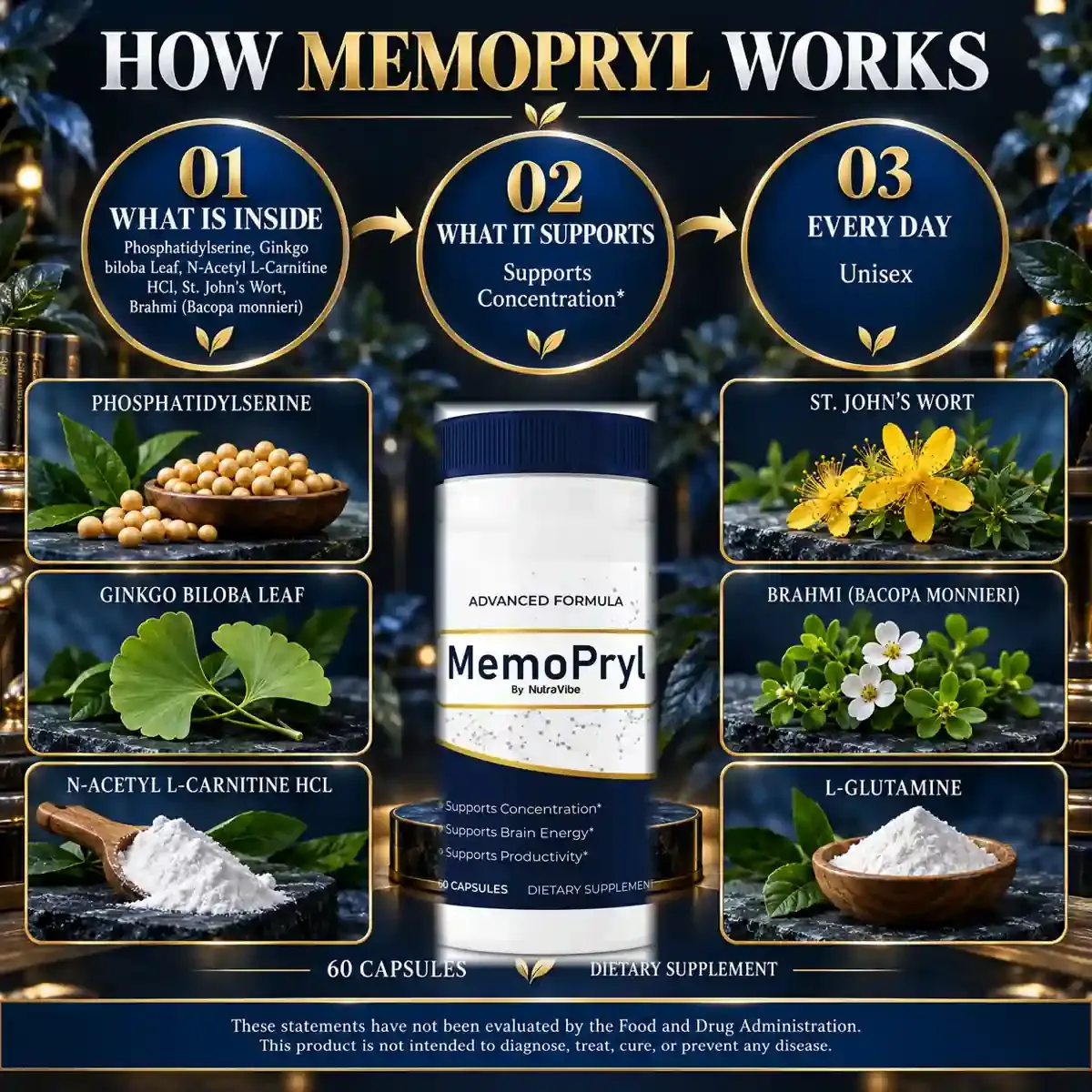
The brand explains Memopryl in three steps. First come the ingredients. Next come the three support areas from the label. Last comes the idea of taking it every day.
That order is a sensible way to think about any focus supplement. What the graphic leaves out is how strong the evidence is for each step. The sections below fill that gap. The full ingredient list is on the Memopryl ingredients page.
How is a daily capsule meant to fit your routine?
One steady routine
Take Memopryl as your bottle directs, at the same time each day. The ingredient studies all used a regular daily dose.
Weeks, not hours
The trials measured change over 12 weeks to 6 months. A single capsule is not expected to do much on its own.
Daily habits carry weight
Sleep, movement and fewer distractions shape focus more than any capsule. The formula is meant to sit alongside them.
A fair check-in
Keep brief notes on focus and energy. Judge the result inside the 60-day refund window.
What was each ingredient studied for?
Each ingredient has its own research story. Some have human trials in people with memory complaints. Others were studied for something else entirely. The table sums up the idea behind each one and what trials in people found.
| Ingredient | The basic idea | What human studies found | Our read |
|---|---|---|---|
| Phosphatidylserine | Part of every cell wall, plentiful in the brain | Modest memory gains in older adults with complaints | Some support |
| Ginkgo biloba leaf | Studied for blood flow in the aging brain | Did not prevent dementia in 3,069 adults | Disappointing |
| N-acetyl L-carnitine | Helps cells move fats into energy-making parts | No clear benefit across 16 trials | Disappointing |
| St. John's wort | Studied for mood, not memory | Mood trials only; many drug interactions | Not a memory ingredient |
| Brahmi (bacopa) | A traditional herb for learning | Better learning in healthy adults at 12 weeks | Strongest single result |
| L-glutamine | A common amino acid used by the brain | A single dose did not help learning | No memory evidence |
Why do lab ideas and human evidence differ?
A lab idea explains how an ingredient might act. A human trial checks whether people actually change. The two often disagree, and the human result is the one that counts.
Acetyl-L-carnitine is a good example. Carnitine helps cells turn fats into energy, so it sounds like a natural fit for brain energy. Yet trials in people with memory problems did not show a clear benefit. Health agencies say direct evidence for natural products and thinking skills is still lacking (NCCIH, supplements and cognition).
That is why we name the study, the dose and the result each time. You can open every source and read it yourself.
Why were the ginkgo trials disappointing?
Ginkgo had high hopes behind it. The GEM trial set out to test it properly. It gave 3,069 adults aged 75 and over 240 mg a day for a median of 6.1 years (DeKosky et al., 2008 (GEM)).
At the end, ginkgo did not lower dementia rates compared with placebo. Federal health sources say there is no conclusive evidence that it prevents or slows cognitive decline (NCCIH, supplements and cognition). It may also raise bleeding risk in people on blood thinners (NCCIH, Ginkgo).
GEM tested older adults and dementia, not everyday focus at work. Still, it is the best data there is. Our post on the big ginkgo trials goes deeper.
Why were acetyl-L-carnitine results weak?
Memopryl lists N-acetyl L-carnitine HCl, a form of acetyl-L-carnitine (ALCAR). In studies of memory impairment, people took 1.5 to 3 g a day for 3 to 12 months (NIH ODS, Carnitine).
A Cochrane review pooled 16 trials. It found no evidence to recommend ALCAR for routine use in dementia (Hudson & Tabet, 2003 (Cochrane)). Some single trials looked hopeful, but the full picture did not hold up.
At about 3 g a day, it can cause nausea, cramps, diarrhea and a fishy body odor (NIH ODS, Carnitine). The Memopryl amount is not published, so there is no way to tell how close a capsule comes.
Why is bacopa the strongest single ingredient?
Bacopa, listed as Brahmi, is the one ingredient with a clean result in healthy adults. That matches the audience for a focus supplement better than trials in people with dementia.
In a placebo-controlled trial, 46 healthy adults took 300 mg of bacopa extract a day. After 12 weeks, learning rate, memory consolidation and processing speed improved more than with placebo (Stough et al., 2001). The change did not show up at earlier checks.
So bacopa rewards patience, not a quick boost. Its side effects are mostly in the stomach (StatPearls, Bacopa). For how that plays out week by week, see the Memopryl results timeline.
Where does phosphatidylserine fit?
Phosphatidylserine sits in the middle. It has a real trial, but in older adults with memory complaints rather than busy workers.
In 78 adults aged 50 to 69, 100 or 300 mg a day for 6 months raised memory scores, mostly in those who started lower (Kato-Kataoka et al., 2010). The FDA allows only a qualified claim that says the evidence is very limited (FDA, qualified health claims).
L-glutamine, by contrast, has no memory support. A single 2 g dose did not help learning or reaction time in 91 students (Jongkees et al., 2017).
Is St. John's wort a memory ingredient?
No. St. John's wort is a mood herb. It is studied at 300 mg three times a day, or 900 mg in total (StatPearls, St. John's Wort). Memopryl makes no mood claim, and the amount in each capsule is not published.
Its main effect that matters here is on medicines. It speeds up the liver enzymes that clear many drugs. That can weaken birth control pills, warfarin, cyclosporine, digoxin, and some HIV and cancer drugs (NCCIH, St. John's Wort). With antidepressants it can cause serotonin syndrome, and it can make skin burn more easily in the sun (MSKCC, St. John's Wort).
Medicine check first
If you take any prescription medicine, check with your doctor or pharmacist before your first capsule. Never stop a prescribed medicine on your own. The full list is on the Memopryl safety page.
What does "supports" mean on the label?
"Supports Concentration" is a structure-function claim. It describes normal body function, not a disease. The asterisk points to the FDA line saying the statement has not been evaluated.
The FDA does not approve dietary supplements before they are sold (FDA, Q&A on Dietary Supplements). So the claim tells you what the formula is designed for, not what a trial proved. The wording is kept on purpose. Memopryl does not claim to treat memory loss, dementia or low mood.
What each claim can and cannot mean is spelled out on the Memopryl benefits page.
What does the evidence mean for you?
Put together, the research gives a mixed but useful picture. One ingredient has a solid result in healthy adults. Two have modest or weak results in older groups. The others are there for other reasons.
Points in its favor
- Bacopa has a placebo-controlled result in healthy adults at 12 weeks
- Phosphatidylserine has a 6-month trial in adults with memory complaints
- One daily capsule is an easy habit to keep
- The 60-day refund window gives time to judge it
Points to weigh
- No trial of the finished formula has been published
- Ginkgo and acetyl-L-carnitine trials were disappointing
- Ingredient amounts are not published, so doses cannot be compared
- St. John's wort means a medicine check comes first
How Memopryl works: FAQ
Has Memopryl itself been tested in a clinical trial?
No trial of the finished Memopryl formula has been published. Everything known so far comes from studies of the single ingredients.
How long does Memopryl take to work?
No timeline has been published for Memopryl. The bacopa trial saw changes only at the 12-week check, so steady daily use over weeks is the fair test.
Is Memopryl a stimulant?
None of the six named ingredients is a stimulant like caffeine. The full other-ingredients line is not published, so read your bottle's label.
Does Memopryl work for dementia or Alzheimer's disease?
No. Memopryl is not made to treat or prevent any disease, and the largest ginkgo trial did not prevent dementia. Noticeable memory changes need a doctor.
Does St. John's wort in Memopryl lift mood?
Memopryl makes no mood claim. St. John's wort is studied for mood at 900 mg a day, and the amount in Memopryl is not published.
Why include ingredients with weak evidence?
The brand has not explained its choices. Many formulas mix ingredients with different levels of support, so we show the evidence for each one.
Can I take Memopryl with coffee?
Coffee is not a known problem with these ingredients. Medicines are the real concern, so check with a pharmacist if you take any prescription drug.
Ready to try Memopryl?
60 capsules per bottle, prices shown at checkout, and a 60-day money-back guarantee. Contains St. John's wort, so check your medicines first. Questions? Call +1 (302) 200-3480.